- Home
- Departments
- Economic Development
- Resources
- Projects & Partnerships
Projects & Partnerships
New Hampshire’s Main Street™
The City of Concord has long been known as the seat of state government, but today it stands as a vibrant and forward-thinking hub of commerce, culture, and community. Thanks to a transformative series of public-private partnerships and civic investments, Concord has reinvented its downtown, drawing a surge of new businesses, residents, and visitors. With a $14 million streetscape overhaul, new infrastructure and accessibility improvements, regulatory reforms, and a deeply engaged business community, Concord has created a downtown environment that supports innovation, creativity, and sustainable growth. From artisan shops and farm-to-table restaurants to modern office space and a growing arts scene, the city offers fertile ground for investment. With strong civic leadership, a collaborative spirit, and unmatched community support, Concord is not just a place to do business—it’s a place to thrive. Businesses that partner with the City of Concord tap into a network of opportunity, shared vision, and ongoing momentum that makes it one of New England’s most promising small cities for growth and prosperity.
Learn more about some of the projects completed in Concord and Penacook through our partnerships with local organizations, businesses and volunteers.
Canal Street, Penacook
Former Allied Leather Tannery / Amazon Realty Redevelopment Project
(Penacook Landing)
1. Overview: The former Allied Leather Tannery was once a sprawling 50-acre industrial complex located in the heart of Penacook Village which spanned the Concord / Boscawen municipal boundary. Approximately 6 acres of the 50+ acre site were located in Concord.
That portion of the complex located in Concord was anchored by the Penacook Mill, an iconic granite structure built in 1846 and operated by hydro power for the manufacturing of sail cloth and other textiles. The textile operation ceased in the 1930's as a result of the Great Depression.
Penacook Mill circa 1846
Penacook Mill Circa 1906
Following the Great Depression, it reopened as a leather tannery. Through a series of mergers and acquisitions, it became the largest tannery in New Hampshire. At the time of its closure in 1987, it employed 300 people.
Following its closure, the Tannery property was mired in bankruptcy until it was purchased by a local entrepreneur in 1997. Despite good intentions, environmental contamination and other issues proved too challenging. Thus, redevelopment efforts did not move forward.
Allied Leather Tannery circa 2001 (Concord Monitor)
Years of decay and neglect caused the property to become a public hazard. Consequently, on June 17, 2002, the City Council passed Resolution #7325, which enacted a Hazardous Building Order against that portion of the Tannery property formerly located at 35 Canal Street.
Penacook Mill partial building collapse viewed from Crescent Street circa 2001
Penacook Mill partial building collapse Viewed from Crescent Street circa 2003
Due to significant environmental issues, coupled with nearly 200,000SF of condemned buildings and the community goals for the site, the City ultimately determined that the private sector would be unable to redevelop this important property. Consequently, in 2003, the City initiated an ambitious plan to acquire all properties that comprised the former Allied Leather Tannery in Concord. By 2006, the City had acquired the 6 properties which comprised the former Tannery complex in Concord. Combined, these parcels totaled 5.78 acres, and were acquired for the sum of $448,351.
In March 2004, the City held a two-day charrette to create a vision and redevelopment plan for the property. This community-based process, which was supported by a team of land use and economic development professionals, crafted a vision for mixed use development at the site, which involved preservation and redevelopment of the Penacook Mill. This effort was successful as it established the community support and vision to guide redevelopment of the site.
The Penacook Mill and Tannery Design Charrette March 2004
Visioning Charrette March 2004
With a vision for the site established, the City set to work on redeveloping the property. In 2004-2005, the City undertook the initial round of environmental clean-up, selective demolition, and structural stabilization of the Penacook Mill. The goal of the demolition process was to remove extraneous additions to the Penacook Mill, as well as stabilize the mill for future redevelopment.
Demolition of modern additions at the Penacook Mill November 2004
Penacook Mill emergency structural stabilization, Fall 2004
Penacook Mill post demolition of modern addition, December 2004
In April 2005, the City entered into a Purchase and Sales Agreement to convey that portion of the site containing the Penacook Mill to a New Hampshire developer who planned to preserve and redevelop the Penacook Mill and related outbuildings into market rate housing. However, the collapse of a large portion of the Penacook Mill in 2007, coupled with financial crisis, led the developer to withdraw from the project. In the Fall of 2008, the City demolished the remaining portions of the Penacook Mill.
Penacook Mill collapse, 2004
Penacook Mill demolition, Summer 2008
In 2012, the City expanded its redevelopment efforts and acquired 0.39 acres of land located at 5-11 Canal Street from Amazon Realty for $99,000. The property, which was part of the original Allied Leather complex and then later a power plant, was acquired to remove blight, as well as further efforts to develop a riverfront park at the Tannery site as envisioned in the 2004 Visioning Charrette.
In 2014, the City completed the final phase of environmental cleanup at the former Allied Leather complex. Environmental cleanup activities undertaken in 2004, 2006, 2008, and 2013 addressed the following contaminants:
- Trivalent & Hexavalent Chromium
- Polynuclear Aromatic Hydrocarbons (PAHs)
- Perchloroethylene (PCE)
- Petroleum
- Polychlorinated biphenyls (PCBs)
- Buried leather scraps
2. 4 Crescent Street Redevelopment: In 2006, the City initiated site specific redevelopment efforts at the 2.11-acre portion of the former Tannery site located at 4 Crescent Street. Work began with demolition of a former waste water treatment plant and electrical substation at the property and other site preparation. In May 2010, the City entered into a Purchase and Sales Agreement with DEW Crescent Street Properties LLC, a Vermont based developer, to redevelop the property. The sale price for the property was $338,134. The redevelopment resulted in a new 15,000SF office building at the site. Today, the building is occupied by Penacook Family Physicians (an affiliate of Concord Hospital) and Warren Street Architects. (Penacook Family Physicians reportedly retained 20 jobs in Penacook and added 7 new positions). In addition to demolition, City support included extensive environmental cleanup (buried leather, coal ash), as well as infrastructure improvements supported by the Penacook Village Tax Increment Finance District. As of April 1, 2025 the property had a total assessed value of $2,227,600 and generated $34,127 in property taxes.
4 Crescent Street before clean up and redevelopment, 2006
Demolition at 4 Crescent Street, 2006
Environmental cleanup - removal of buried leather on foot print of new office building, 2001
Reconstruction of Crescent Street supported by Penacook Village Tax Increment Finance District Bond, 2011
4 Crescent Street, 2001
3. 33/35 Canal Street Redevelopment: Extensive demolition and environmental clean-up efforts at the property occurred in 2004, 2008, and 2014. In 2017, the City entered into a Purchase and Sales Agreement with the Caleb Group to redevelop 2.4 acres of this property for redevelopment into a 54-unit affordable housing development (rental). (Residual portions of the property were retained by the City for the Canal Street Riverfront Park). The 2.4 acre portion of the site was acquired by Caleb from the City in 2019 for $540,000. The property was developed in two phases. Phase I featured 34 housing units and was completed in 2020. Phase II featured 20 units and was completed in 2023. The placement, size, and mass of the new apartment buildings were specifically designed to be reminiscent of the former Penacook Mill. In addition to aforementioned environmental cleanup and demolition, the City directly supported the Caleb project with $500,000 Community Development Block which supported demolition of residual buildings at the property, construction of a private sewer pump station and other site improvements, as well as a $600,000 loan from the City’s Revolving Loan Fund which provided part of the financing package for Phase II apartments. As of April 1, 2025 the property had a total assessed value of $3,914,765 and generated $119,948 in property taxes. Because the property includes affordable housing, the assessed value is calculated in accordance with RSA 75:1-a assessment.
Penacook Landing phase I and II, 2024
4. 11 Canal Street (Canal St Riverfront Park): Following the sale of 33-35 Canal Street to the Caleb Group, the City began efforts to develop a riverfront park at 11 Canal Street. A riverfront park at this location was first conceived in the City’s 1986 Penacook Village Master Plan, and was later confirmed by the 2004 Allied Leather Tannery / Penacook Mill Visioning Charrette and reconfirmed in the 2015 Penacook Village master plan funds for design were appropriated in City FY2022. Construction funds were subsequently appropriated in FY2023 and FY2024. Construction of the 1.75 acre park and new Canal Street Municipal parking lot began in 2024 and were completed in 2025. The park features a pavilion, walking paths linking to Canal Street and Crescent Street, and scenic overlooks at the Contoocook River. Programming in the park includes seasonal concert series by the Parks and Recreation Department. The project also included sidewalk and streetscape improvements on Canal Street, including a 10’ shared use path which will eventually connect to the Merrimack River Greenway Trail / Northern Rail Trail, and new bus stop for Concord Area Transit. The total budget for the Park was $3,369,800, and was financed by Tax Increment Financing District bonds ($2,525,0000, Parking Fund supported bonds ($160,000), development impact fees ($179,800), as well as a Land and Water Conservation Fund Grant ($500,000).
Canal Street Riverfront Park (Viewed from Village Street, 2024)
Canal Street Riverfront Park (Viewed from Contoocook Rover Overlook, 2025)
5. Economic Development Goals: This project achieved the following City goals:
- Remove Blight
- Business Retention / Expansion
- Housing Expansion
- Job Retention / Expansion
- Long-term Property Tax Growth
6. Tax Base Generation & Property Tax Revenues
Redevelopment of 4 Crescent Street and 33/35 Canal Street resulted in the development of 67,811SF of new buildings on 4.52 acres with a combined assessed value of $6,142,365 (or $1,358,930 / acre). Total property taxes in 2024 were $188,202, combined.
7. City Investment Summary (2002-2025)
- Gross Investment (City and Non-City Funds): $9,387,412 (all funding sources; excludes $600,000 Loan from City Revolving Loan Fund Program to Penacook Landing Phase II)
- Net Investment: $8,210,079+/- (all funding sources; net of revenue from sale of properties & other reimbursements)
- Net Investment City Funds: $4,296,215 (52%)
- Net Investment Non-City Funds: $3,913,865 (48%)
8. Key Partners
- US Department of Housing and Urban Development – Economic Development Initiatives Program / US Senator Judd Gregg ($1,393,640)
- US Environmental Protection Agency ($1,000,000)
- Capital Regional Development Council Brownfields Program / US Environmental Protection Agency ($325,000)
- NH Department of Cultural & Natural Resources / Division of Parks & Recreation with US Department of Interior Land & Water Conservation Fund Program ($500,000)
- NH Community Development Finance Authority Community Development Block Grant Program ($500,000)
- NH Department of Environmental Services Petroleum Reimbursement Fund ($120,225)
- Briar Hydro Associates / Essex Hydro (Property Rights for Canal St Riverfront Park)
Aerial of Canal Street and Crescent Street, 2001
Aerial of Canal Street and Crescent Street, 2008
Aerial of Canal Street and Crescent Street, 2012
Aerial of Canal Street and Crescent Street, 2025
177 North Main Street
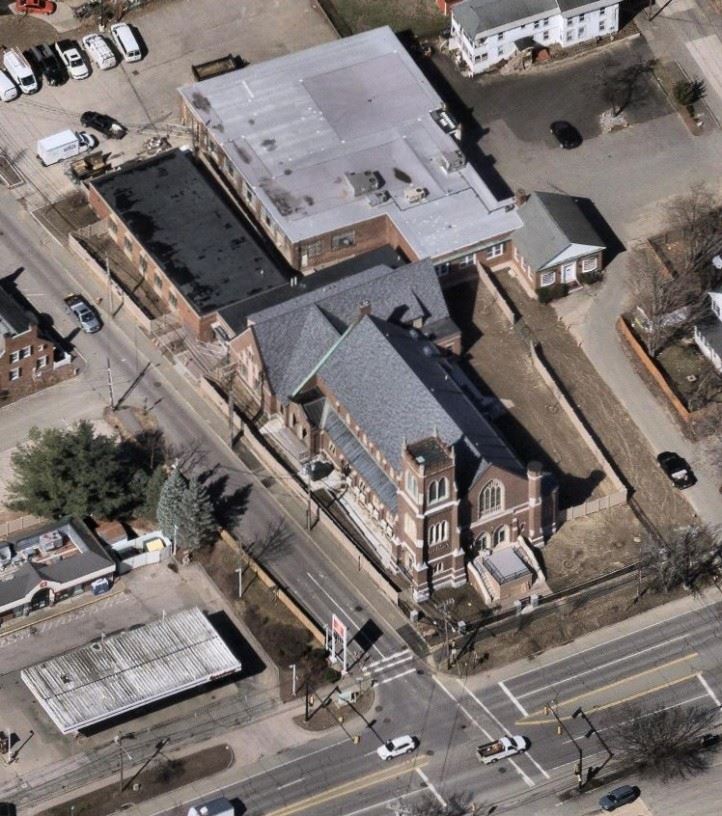
First Congregational Church’s history in the community dates to 1730. The former church presently located at 177 North Main Street was erected in 1937, and later expanded in 1967.
Local developers Jon Chorlian and Ben Kelley, doing business as First Church Holdings LLC, acquired the former property, investing approximately $5.8 million for the purpose of preserving and renovating the building into 30 units of market rate rental housing. The project has brought a formerly tax-exempt property on to the City’s tax roll, increasing the property’s assessed value by over $1.7 million.
The City determined that without the use of the 79-E incentive, the developers would not have had sufficient capital to undertake the project and that the incentive would also be a mechanism to achieve historic preservation, housing, and economic goals of the City. The City Council granted the final amended RSA 79-E request from First Church Holdings in 2024 for a period of seven years, with a total projected tax benefit of almost $400,000.
If you would like to learn more about Community Revitalization Tax relief Incentive RSA 79-E, download program requirements and an application here.
43-47 Washington Street
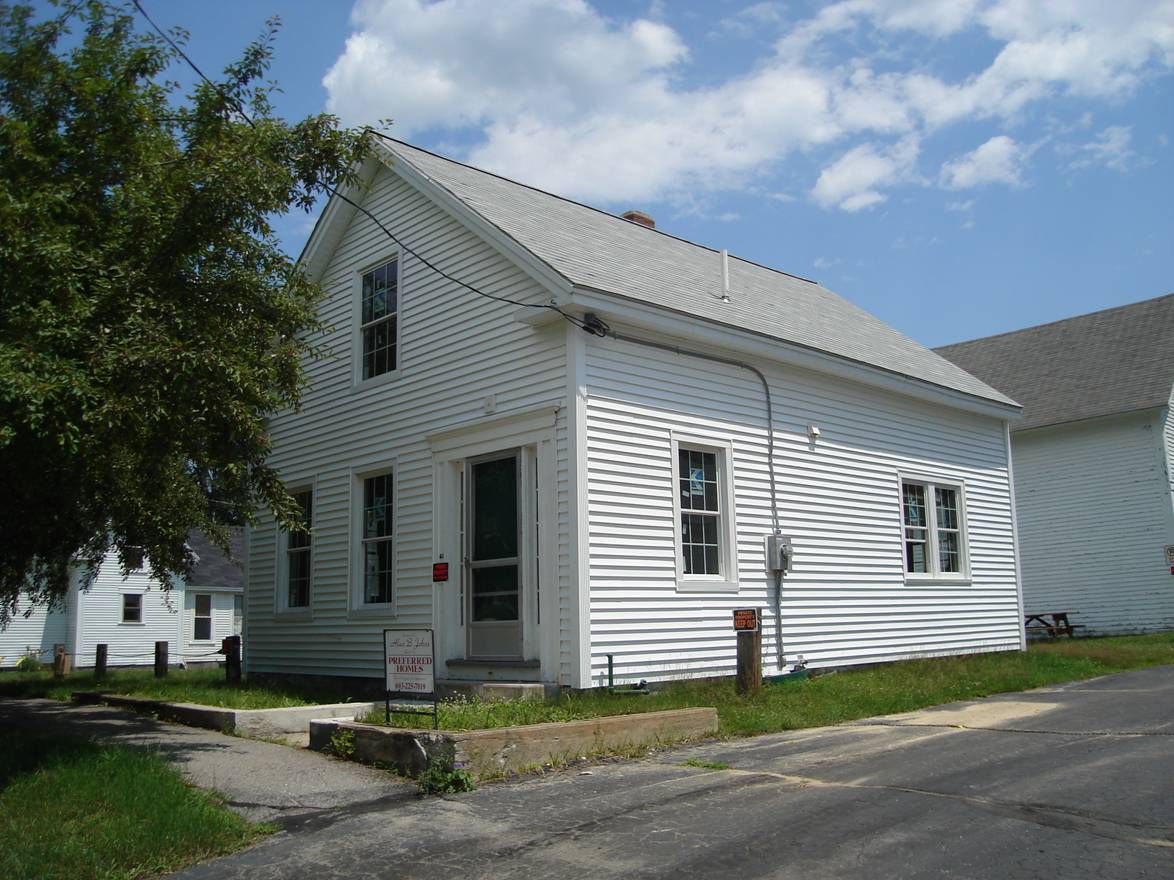
The two-buildings located at 43 - 47 Washington Street were originally constructed circa 1880. In 1955, Hoyt Electrical purchased the two residential houses which were used by the company until the 1970’s. After decades of vacancy, Washington Street Estates, LLC purchased the properties. The buildings had a combined 11,582 SF. Washington Street Estates, LLC invested $1.02 million dollars to redevelop the properties to create eight 2-bedroom residential condominium units.
In 2008, Washington Street Estates, LLC applied for RSA 79-E Community Revitalization Tax Relief Incentive. RSA 79-E is a local option statute designed to support revitalization of downtown and village centers by providing property tax incentives for qualifying real estate development projects.
The City determined that without the use of the 79-E incentive, the developer would not have had sufficient capital to undertake the project and that the incentive would also be a mechanism to achieve historic preservation and housing goals of the City. The City Council granted the RSA 79-E for the projects in 2008 for a period of five years for the residential portion, with a total tax benefit of approximately $115,000.
The project was completed in 2010. The RSA 79-E benefit expired on March 31, 2017. The project redeveloped a blighted, vacant building, created 8 units of new housing, and preserved historically significant building. At the time of RSA 79-E award, the property had an assessed value of $185,000. As of 2025, the property had an assessed value of $1,081,900 and generates $16,574.71 of property taxes annually for the City, Merrimack Valley School District, Merrimack County, and State of New Hampshire, combined.
If you would like to learn more about Community Revitalization Tax relief Incentive RSA 79-E, download program requirements and an application here.
45 A, 47-49 South Main Street
The former Sanel Block was built between 1926-31 as an automobile service station and dealership which operated until 1935. Sanel Auto Parts operated out of the location as early as 1936.
Duprey Acquisitions, LLC purchased the properties in 2009 (in addition to several other neighboring properties. Located directly across the street from the state’s largest performing arts center, Capital Center for the Arts, Duprey Acquisitions invested $10.5 million to redevelop the area into a total of 136, 500SF (45, 000 SF of affordable housing for CATCH and a 91,500 SF 5 story mixed use office building space now known as the “Smile” Building).
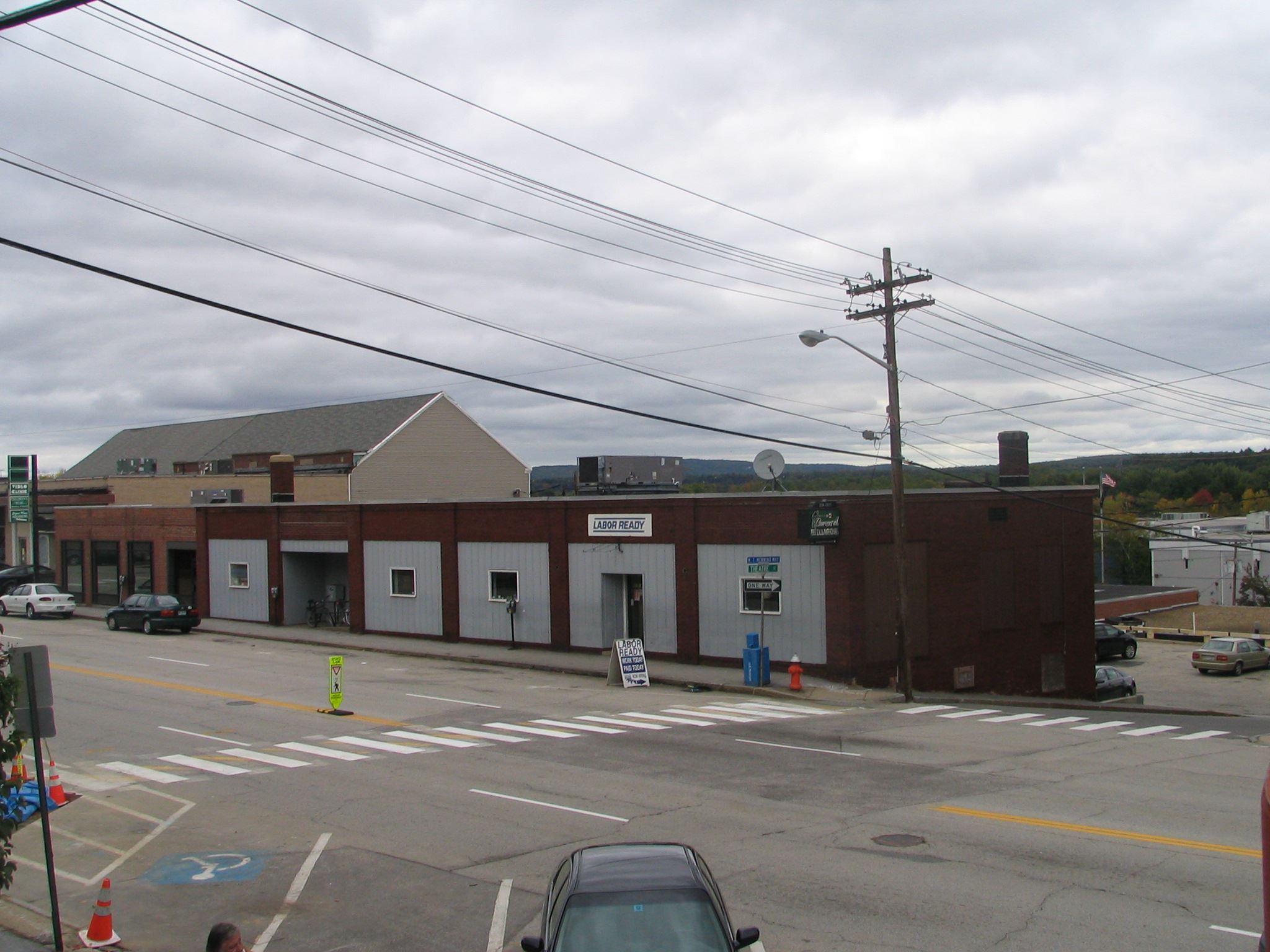
The project incorporated RSA 79-E Community Revitalization Tax Relief for the commercial office building portion of the project (did not apply to the residential portion). The City also provided a below market Parking Lease in Storrs Street Parking Garage (150 spaces, 20 years), sale of City Owned property for a new surface parking lot, approved regulatory amendments (Zoning, Solid Waste District), and secured a $450,000 Community Development Block Grant for the affordable housing component of the project.
The City determined that without the use of the 79-E incentive, the developer would not have had sufficient capital to undertake the project and that the incentive would also be a mechanism to achieve economic development goals of the City. The City Council granted the RSA 79-E for the project in 2009 for a period of five years, with a total projected tax benefit of almost $1.3 million.
The project was completed 2012. The RSA 79-E benefit expired on March 31, 2017. The project redeveloped an underutilized site, created XSF of new buildings (Office 80,000 SF; Residential YSF); and created X units of affordable housing. Additionally, the project was instrumental in keeping the League of NH Craftsmen in Concord, relocated the Greater Concord Chamber of Commerce back to downtown, and also created an office presence for Concord Hospital in Downtown Concord. In 2009, the site had an assessed value of $768,381 and generated $Y in taxes. In 2025, the office building and apartments have a combined assessed value of $9,059,500 and generates $125,428.78 of property taxes annually for the City, Merrimack Valley School District, Merrimack County, and State of New Hampshire, combined.
If you would like to learn more about Community Revitalization Tax relief Incentive RSA 79-E, download program requirements and an application here.
3 South Main Street (Endicott Hotel)
This building, initially known as Blanchard’s Block, was constructed for dry goods dealer Charles G. Blanchard in 1894. It was later sold to the former Governor John B. Smith in 1908. The Smith Family renovated the building between 1914-1920 and converted the upper story office space into Hotel Endicott. Due to its close proximity to the railroad depot, the Endicott remained a hotel for over fifty years. In 1985, the upper stories of the Hotel Endicott were converted into income-restricted apartments.
Concord Area Trust for Community Housing (CATCH) purchased the property in 1994. The four story, 32,701 SF mixed-use building currently features retail and residential use.
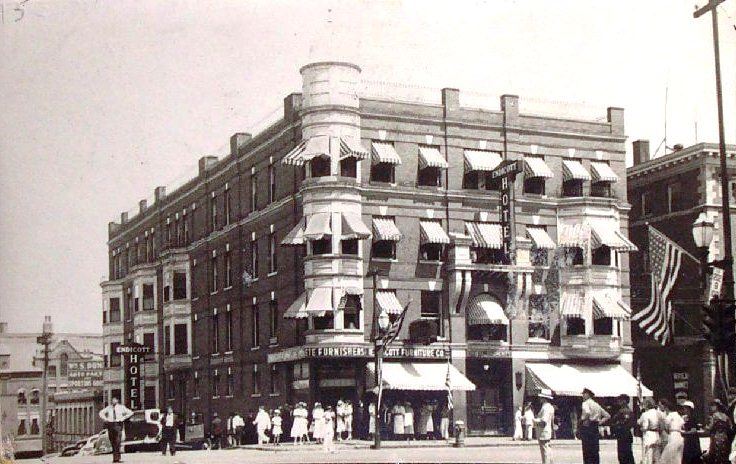
In 2011, CATCH embarked on a plan to redevelop this property into the first major market rate residential development in Downtown Concord in decades. However, that effort was complicated by a fire in 2012 which caused extensive water and smoke damage to the property.
The redevelopment plan involved converting 36 units of income-restricted apartments into 25 market rate and renovating the three commercials units. The total project cost was $4,573,100.
Tenants of the income restricted units were relocated to the CATCH’s Mennino Place property, which was constructed in 2011 at 51 Storrs Street as part of the Smile Building redevelopment project, as well as other CATCH affiliated properties in the area.
The City supported the redevelopment of this historic property with the following:
1) Two separate RSA 79-E Community Revitalization Tax Relief Incentives for the property, on account that the residential and commercial portions of the building were separate condominium units. The City Council granted the RSA 79-E for the projects in 2012 for a period of three years for the commercial portion, and five years for the residential portion, with a total combined tax benefit of just over $80,000.
2) A low interest loan of $150,000 (with the initial payments deferred for 18 months) from the City’s Revolving Loan Fund Program to complete a historic renovation of the façade of the building; and, assistance with releasing of Community Development Block Grant (CDBG) restrictions on the property.
The City determined that without the use of the 79-E incentive, the developer would not have had sufficient capital to undertake the project and that the incentive would also be a mechanism to achieve economic development, historic preservation, and housing goals of the City.
The project was completed 2014. The RSA 79-E benefit expired on March 31, 2017 and March 31, 2019, respectively. The project redeveloped a fire damaged, historic property into 25 units of market rate housing, and multiple businesses including a credit union and restaurant. In 2025, the residential and commercial condominium units have a combined assessed value of $2,342,200 and generates $32,427.76 of property taxes annually for the City, Concord School District, Merrimack County, and State of New Hampshire, combined.
If you would like to learn more about Community Revitalization Tax relief Incentive RSA 79-E, download program requirements and an application here.
